






Description
Trademark Registration
in India
Protect your brand name, logo, and identity with a legally recognised trademark. Expert filing, real-time updates, and end-to-end support — all in one place.
What is a Trademark?
A trademark is an intellectual property right that distinguishes the goods or services of one entity from those of others in the market. It can be a word, name, logo, symbol, tagline, sound, shape, or a combination of these elements.
In India, trademarks are governed by the Trade Marks Act, 1999. Once registered, your trademark gives you a legal shield — preventing competitors from using a mark identical or deceptively similar to yours.
Trademark (Unregistered)
Use from the date of application filing. Indicates ownership claim — no registered rights yet.
Registered Trademark
Use only after Registration Certificate is issued. Full legal protection under Trade Marks Act, 1999.
Key Benefits of Trademark Registration
Legal Protection
File a suit against anyone who misuses or infringes your trademark.
Exclusive Rights
Only you can use the mark in your registered class of goods/services.
Valuable Asset
Your trademark can be sold, licensed, or used to raise business valuation.
Global Expansion
Simplifies international filing through the Madrid Protocol.
Brand Recognition
The ® symbol builds customer trust and brand loyalty.
Franchise Ready
A registered mark is the backbone of any licensing or franchise model.
Plans & Pricing
IndiStart MSME
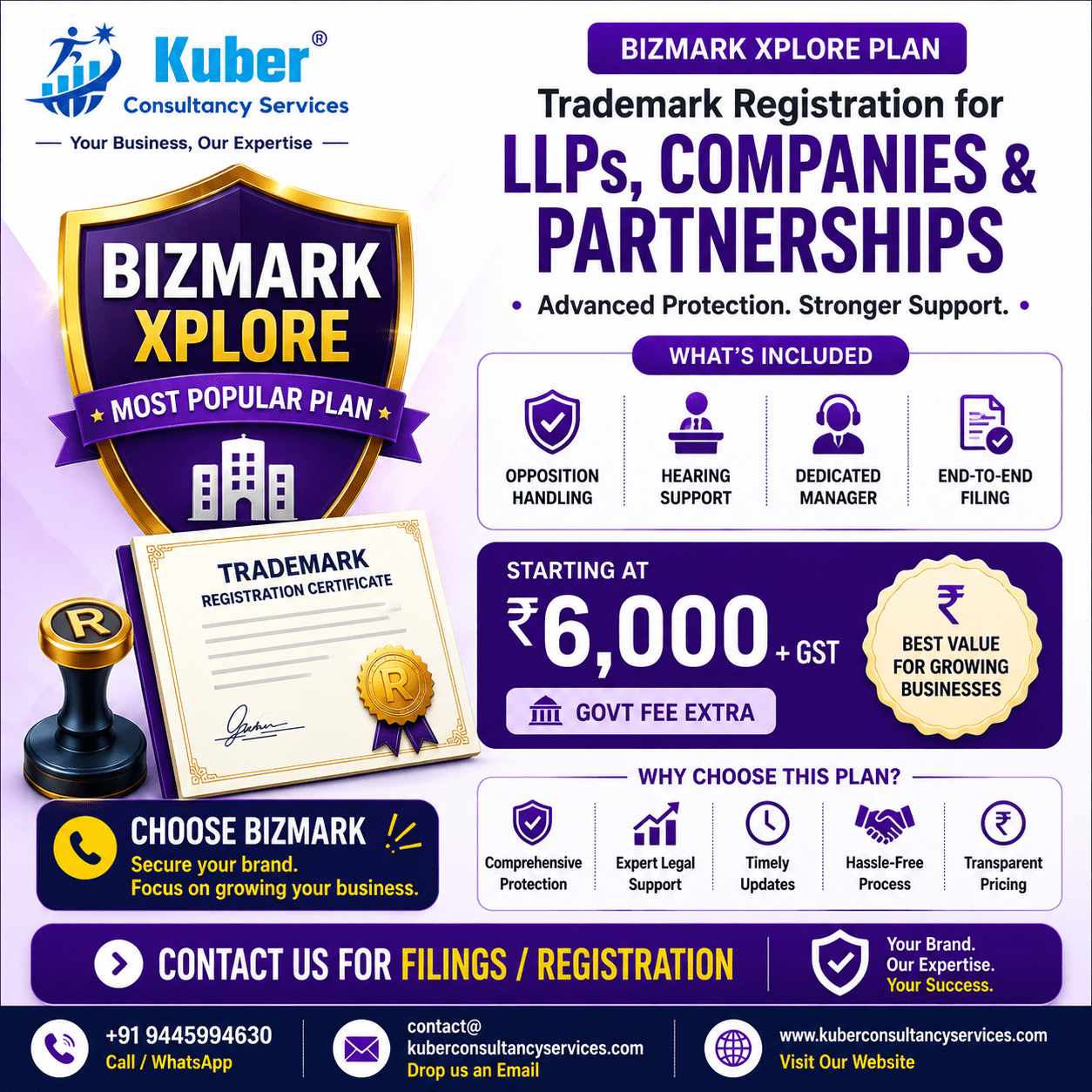
BizMark Xplore
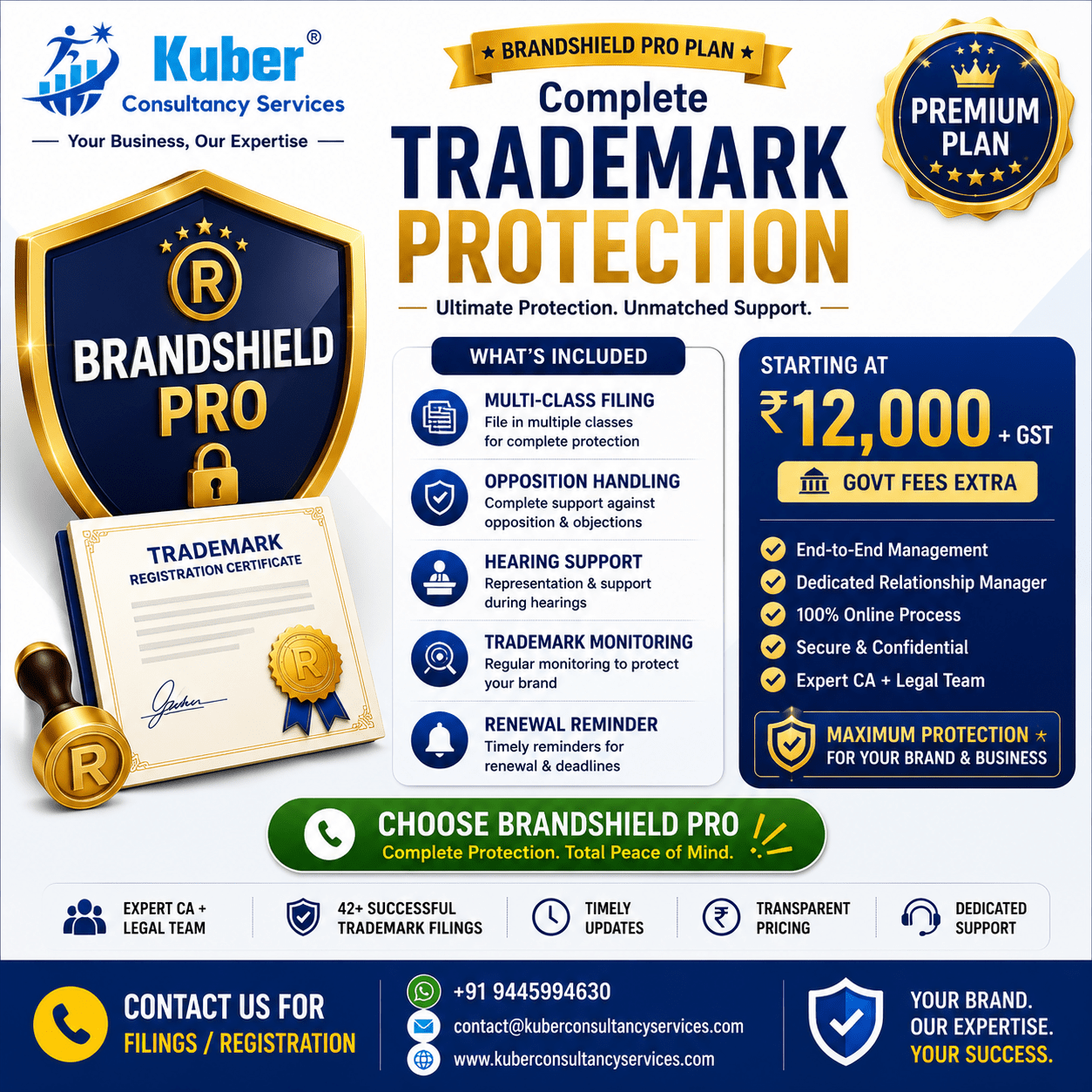
BrandShield Pro
| Feature | IndiStart MSME | BizMark Xplore | BrandShield Pro |
|---|---|---|---|
| Trademark Consultation | ✅ | ✅ | ✅ |
| Trademark Search & Analysis | ✅ | ✅ | ✅ |
| Class Selection Advisory | ✅ | ✅ | ✅ |
| Authorisation Letter / NOC Prep | ✅ | ✅ | ✅ |
| Application Filing (Form TM-A) | ✅ | ✅ | ✅ |
| Dedicated Business Manager | ✅ | ✅ | ✅ |
| Real-Time Status Updates | ✅ | ✅ | ✅ |
| Response to Exam Objections | ✅ | ✅ | ✅ |
| Opposition Handling | ❌ | ✅ | ✅ |
| Hearing Attendance Support | ❌ | ✅ | ✅ |
| Multi-Class Filing (up to 3) | ❌ | ❌ | ✅ |
| Post-Registration Monitoring | ❌ | ❌ | ✅ |
| Renewal Reminder & Support | ❌ | ❌ | ✅ |
| Offer Price (incl. GST) | ₹2,360 | ₹7,080 | ₹14,160 |
| Govt. Fee (Extra) | ₹4,500 | ₹9,000 | Per class |
Additional Services
MSME Registration
Udyam Registration — unlocks lower govt. fees (₹4,500 instead of ₹9,000)
Startup India Registration
DPIIT recognition — enables concessioned trademark fees
Digital Signature Certificate (DSC)
Required for IP India online portal filing
Trademark Renewal
Renew your trademark every 10 years to maintain protection
Trademark Watch / Monitoring
Ongoing monitoring for conflicting marks in the Registry
International Trademark (Madrid)
Single-window application for global trademark coverage in 130+ countries
Trademark Registration Process in India
Place Your Order & Download Formats
- Select your plan and complete the order on our website.
- Download the Authorisation Letter and NOC formats from your File Manager.
- Download the Checklist to fill in your trademark details.
Upload Your Documents
- Upload all required documents through the File Manager in your account.
- Documents: PAN, Aadhaar, Business Proof, Logo, Authorisation Letter, NOC, Address Proof.
- If you opted "Prepare documents for me," our team will draft the Authorisation Letter and NOC.
Business Manager Verification
- Your assigned Business Manager verifies all documents for completeness and accuracy.
- Any clarification is communicated via the App Messenger on the website.
Trademark Application Filing (Form TM-A)
- Our team files Form TM-A on the IP India portal.
- You receive the Application Number and Filing Acknowledgement.
- You can start using the TM symbol from this date onwards.
Regular Status Updates
- Status updated in your client portal every 1–2 weeks or upon any Registry change.
- Track real-time status from your account — no need to call or email.
Objection / Opposition Handling (If Applicable)
- If the Registry issues an Examination Report with objections, our team drafts and files a detailed reply.
- If a third party raises an opposition (4-month window), we handle the counterstatement and hearings (BizMark Xplore & BrandShield Pro).
Certificate & Completion ✅
- Registration Certificate is uploaded to your File Manager — accessible anytime.
- All documents stored safely in your account for future reference.
A thorough search of the IP India trademark database ensures your proposed mark is unique and does not conflict with existing registrations. Our team assesses identical and deceptively similar marks, their status, and class coverage — minimizing objection risk before filing.
Trademarks are filed under specific classes based on goods or services. The internationally recognized NICE Classification system has 45 classes (34 for goods, 11 for services). Filing in the correct class is critical — a wrongly classified application may offer incomplete protection.
Form TM-A is filed on the IP India portal capturing applicant details, trademark representation, goods/services description, and applicable class. An application number is generated immediately upon filing.
The Registry examines the application for distinctiveness, conflicting marks, and compliance with the Trade Marks Act. If objections are raised in an Examination Report, a detailed response must be filed within 30 days (extendable). Our team handles this as part of your plan.
If the application passes examination, it is published in the Official Trademark Journal. This opens a 4-month opposition window during which any third party can challenge the registration. If no opposition is raised, the mark proceeds to registration.
If a third party files an opposition, we represent you in proceedings — filing counterstatements, submitting evidence, and attending hearings before the Registrar of Trademarks. This is included in BizMark Xplore and BrandShield Pro plans.
Once all stages are cleared, the Trademark Registration Certificate is issued. This is official proof of your exclusive rights. You can now use the ® symbol legally alongside your brand.
Trademarks must be filed under the appropriate NICE Classification class. Here are the most common classes for Indian businesses:
Pharmaceuticals
Medicines, health supplements, sanitizers
Paper / Stationery
Books, printed material, packaging
Clothing
Garments, footwear, apparel brands
Food (Processed)
Dairy, packaged vegetables, meat products
Beverages / Staples
Tea, coffee, rice, spices, bakery
Business Services
Advertising, retail, import-export, HR
Financial Services
Insurance, banking, fintech
Education / Entertainment
Training institutes, events, edtech
IT / Tech Services
Software, SaaS, app development
Food Services
Restaurants, hotels, catering
Medical Services
Clinics, hospitals, healthcare
Legal Services
Legal, IP, compliance consultancy
Eligibility Criteria
The mark must be unique and distinguishable from existing marks in the same class. Invented words, unique combinations, or marks with acquired distinctiveness are preferred.
Trademarks that merely describe the goods/services are generally not eligible for registration. For example, "Sweet" for a candy brand or "Fast" for a courier service would typically be refused.
The mark should not be identical or deceptively similar to existing registered trademarks. A thorough search before filing significantly reduces this risk.
The mark must be capable of being represented graphically. For unconventional marks (sound, smell, shape), a detailed description or notation meeting Registry standards is required.
Proposed Use: You can file even if you haven't started using the mark yet — no proof required at filing.
Current Use: If already in use, proof (invoices, advertisements, packaging) significantly strengthens your application.
Documents Required
📌 For All Applicants
PAN Card
Individual or business entity PAN. Mandatory for all applicants.
💡 Keep a self-attested copy readyAadhaar Card
For individuals and proprietors. Alternatively: Passport or Driving License.
💡 JPEG or PDF acceptedTrademark / Logo Image
High-resolution JPEG format. Required if registering a device or logo mark.
💡 Min. 300 DPI, white backgroundAuthorisation Letter / POA
Authorising our team to file on your behalf. We prepare this if you opt in.
💡 We draft this for youGoods / Services Description
Detailed description of goods or services covered by the trademark.
💡 We help you frame thisNOC (if applicable)
No-Objection Certificate from brand owner if filing on behalf of another entity.
💡 Required for third-party filing📂 Additional Documents by Entity Type
Address Proof of Business
Property Tax Receipt, Rental Agreement, or Electricity Bill
💡 Must show your trading addressPAN + Aadhaar
Personal PAN and Aadhaar of the proprietor
Certificate of Incorporation
Issued by MCA / ROC at the time of company or LLP registration
MOA / AOA (Optional)
Memorandum and Articles of Association for companies
💡 Optional but helps in class selectionLLP Agreement
Required for LLPs as proof of business entity
Partnership Deed
Registered or unregistered deed with all partner names (up to 10)
Trust Deed / Registration Certificate
For Trusts and Societies — registration certificate required
Udyam Registration Certificate
For MSME holders — enables concessioned govt. fee of ₹4,500
💡 Don't have one? We can register you for ₹399DPIIT Startup India Certificate
For Startups — enables concessioned trademark fees
💡 We offer Startup India registration for ₹2,999Incorporation Documents
From home country — must be notarized and apostilled
💡 Apostille required for The Hague Convention countriesAuthorized Indian Agent Details
Foreign entities must file through an authorized Indian trademark agent
Trademark Application Status Explained
⚡ Objection vs Opposition — What's the Difference?
| Examination Objection | Third-Party Opposition | |
|---|---|---|
| Raised By | Trademark Registrar / Examiner | Any third party (public, competitors, brand owners) |
| When | During examination (before journal publication) | Within 4 months of Trademark Journal publication |
| Response Required | Examination Reply / Hearing | Counterstatement, Evidence, Hearing |
| Our Role | Draft & file reply — included in all plans | Full representation — BizMark Xplore & BrandShield Pro |
Trademark Renewal
| Aspect | Details |
|---|---|
| Validity Period | 10 years from date of registration |
| Renewal Form | Form TM-R |
| Renewal Govt Fee | ₹4,500 (Individuals/MSME) · ₹9,000 (Others) — per class |
| Grace Period | 6 months after expiry (with late filing surcharge) |
| Consequence of Non-Renewal | Trademark lapses and becomes available for third-party filing |
| Renewal Support | Included in BrandShield Pro — renewal reminders & filing assistance |
Trademark for Licensing & Franchise
A registered trademark is not just a protection tool — it is a revenue-generating asset. Once registered, you unlock powerful business opportunities:
License Your Trademark
Allow others to use your mark through a Trademark License Agreement — earn royalties without losing ownership.
Franchise Your Business
Use your registered mark as the core brand identity for a scalable franchise model.
Assign / Sell
Transfer your trademark to another entity through a formal Trademark Assignment Agreement.
Collateral for Loans
Pledge your trademark as an intangible asset when seeking business loans from banks.
Raise Valuation
A registered trademark signals brand seriousness — boosts your business value during investor pitches or fundraising.
Comparison Tables
| Aspect | Trademark | Copyright |
|---|---|---|
| Law | Trade Marks Act, 1999 | Copyright Act, 1957 |
| Protects | Brand names, logos, slogans, sounds, shapes | Literary, artistic, musical, dramatic works, software |
| Protection Period | 10 years (renewable indefinitely) | Author's lifetime + 60 years |
| Registration | Recommended (not mandatory) | Automatic on creation; registration optional |
| Filing Authority | CGPDTM (Trademark Registry) | Copyright Office, Ministry of Commerce |
| International Treaty | Madrid Protocol | Berne Convention |
| Time to Register | 18–36 months | 2–6 months (if registered) |
| Examples | Nike logo, Tata name, McDonald's tagline | RRR film, AR Rahman songs, novels |
| Aspect | Trademark | Patent |
|---|---|---|
| Law | Trade Marks Act, 1999 | Patents Act, 1970 |
| Protects | Brand identity — names, logos, symbols | Inventions — new products, processes, compositions |
| Protection Period | 10 years (renewable indefinitely) | 20 years (non-renewable) |
| Registration | Recommended | Mandatory |
| Filing Authority | CGPDTM | Indian Patent Office |
| International Treaty | Madrid Protocol | Patent Cooperation Treaty (PCT) |
| Time to Register | 18–36 months | 2–3 years |
| Examples | Tata logo, Amul tagline | Pfizer vaccine patent, Apple Face ID |
| Aspect | Trademark | Design Registration |
|---|---|---|
| Law | Trade Marks Act, 1999 | Designs Act, 2000 |
| Protects | Brand identity used in commerce | Visual / aesthetic appearance of a product |
| Protection Period | 10 years (renewable indefinitely) | 10 years (extendable by 5 years) |
| Registration | Recommended | Mandatory |
| Filing Authority | CGPDTM | Design Wing, Indian Patent Office |
| Time to Register | 18–36 months | 6–12 months |
| Examples | Nike swoosh logo, Parle-G name | Coca-Cola bottle shape, textile patterns |
Why Choose Kuber Consultancy Services?
42+ Applications Filed
Proven track record across industries, entity types, and NICE classes.
5-Star Client Rating
Consistently rated 5/5 by businesses we have served. Client trust is our priority.
Dedicated Business Manager
Single point of contact for your entire trademark journey — from order to certificate.
Real-Time Status Updates
Track your trademark status from your client account — no chasing required.
Secure Document Manager
All certificates and documents stored safely in your account — accessible anytime.
Transparent Pricing
No hidden fees. Government fees are clearly separated and disclosed upfront.
Technology-Driven Process
Seamless online ordering, document upload, status tracking, and communication — all in one platform.
CA + Legal Expert Team
Services backed by Chartered Accountants and IP compliance professionals.
End-to-End Support
From consultation to Registration Certificate — and beyond with renewal and monitoring services.
Frequently Asked Questions
A trademark is a unique identifier — a word, name, logo, symbol, slogan, sound, or combination — that distinguishes the goods or services of one entity from those of others in the market. It is your brand's legal identity under the Trade Marks Act, 1999.
Any individual, sole proprietor, partnership firm, private or public company, LLP, trust, society, or foreign entity can apply for a trademark in India — even if not currently engaged in business.
Typically 18 to 36 months, depending on the Registry's workload, objections raised, and any opposition proceedings. You can opt for expedited examination (Form TM-M, additional ₹20,000 govt fee per class) to fast-track the examination stage to a few weeks.
Expedited examination (Form TM-M) with an additional govt. fee of ₹20,000 per class fast-tracks the Registry's examination. This can reduce the examination stage from many months to just a few weeks. Our team can assist with this on request.
TM can be used from the date of application filing — it indicates your ownership claim but offers no registered rights yet. ® can only be used legally after the trademark is officially registered and the Registration Certificate is issued.
An objection is raised by the Trademark Examiner during the examination stage (before journal publication). An opposition is filed by a third party after the trademark is published in the Trademark Journal (within 4 months of publication). Both are handled by our team as part of your plan.
Yes. You can file a trademark application for proposed use even before you start using the mark commercially. No proof of current use is required at the time of filing.
A registered trademark is valid for 10 years from the date of registration. It can be renewed indefinitely in 10-year intervals by filing Form TM-R before expiry.
Yes. A registered trademark can be licensed (allowing others to use it for royalties), assigned/sold to another entity through an Assignment Agreement, or pledged as collateral for business loans. Kuber Consultancy Services can assist with these agreements.
An unrenewed trademark lapses after expiry. You have a 6-month grace period to renew with a surcharge. Beyond that, re-registration is required. A lapsed trademark becomes publicly available — any third party could register it.
You can send a legal notice to the infringer, file a suit in the appropriate Commercial Court or High Court for injunction and damages, or report counterfeiting to law enforcement. Kuber Consultancy Services can assist with drafting infringement notices.
Yes. Through the Madrid Protocol, a single application filed through the Indian Trademark Registry can extend protection to over 130 member countries. Contact us for international trademark filing assistance.
Not legally mandatory, but highly recommended. A professional trademark search minimizes the risk of objections and rejection due to conflicting marks. Our team conducts a thorough search as part of all plans.
Ready to Protect Your Brand?
Join 42+ businesses that trust Kuber Consultancy Services for their trademark registration. Select a plan above and get started today.
Trademark Registration Services in India
Protecting intellectual property is vital for every business or individual seeking to build a strong and recognizable brand. Trademark registration in India is a crucial step toward safeguarding your brand name, logo, slogan, or any unique sign that represents your business. At Kuber Consultancy Services, we specialize in providing a seamless and efficient trademark registration experience tailored to meet your specific needs. This detailed guide explains every aspect of our trademark registration services, highlighting how we help you protect and enforce your brand identity.
What is a Trademark?
A trademark is an intellectual property that distinguishes the goods or services of one entity from those of others in the market. It can be in the form of a word, name, logo, symbol, tagline, or even a combination of these elements. A trademark becomes the face of your business, embodying its reputation and trustworthiness.
In India, trademarks are governed by the Trade Marks Act, 1999, which provides exclusive rights to trademark owners and protects them against unauthorized use or infringement. The act also allows the registration of unconventional marks such as sound, smell, and shape marks, provided they meet the distinctiveness criteria. By registering your trademark, you gain a legal shield that prevents others from using a mark similar to yours without permission.
Benefits of Trademark Registration
- Legal Protection: Trademark registration offers legal protection to your brand against misuse or infringement. It gives you the exclusive right to sue anyone attempting unauthorized use of your registered mark.
- Exclusive Ownership Rights: Once registered, the trademark owner gains exclusive ownership rights, meaning only you can use the trademark in the registered class for the specified goods or services.
- Enhances Brand Recognition: A trademark helps customers easily identify your products or services, fostering brand loyalty and trust. It serves as a symbol of quality and reliability.
- Creates a Valuable Asset: A registered trademark becomes an intangible asset for your business. It can be sold, franchised, or licensed, contributing to the overall valuation of your business.
- Supports Global Expansion: Registration in India can simplify international trademark registration through treaties like the Madrid Protocol, allowing you to protect your brand globally.
Trademark Registration Process in India
Registering a trademark in India involves multiple steps, each requiring precision and adherence to legal protocols. Here is a detailed breakdown of the process:
- Trademark Search: The process begins with a thorough trademark search to ensure that your proposed trademark is unique and does not conflict with any existing marks. A detailed search involves scanning the database maintained by the Trademark Registry and assessing similar marks, their status, and potential objections. Our team conducts this search meticulously to minimize the risk of objections during the registration process.
- Classification Selection: Trademarks are registered under specific classes based on the type of goods or services they represent. The NICE Classification system, recognized internationally, includes 45 classes – 34 for goods and 11 for services. Accurately identifying the relevant class is crucial for a valid registration. We guide you in selecting the right class to ensure comprehensive protection of your trademark.
- Application Filing: Once the trademark search is complete and the class is determined, the application (Form TM-A) is filed with the Trademark Registry. The application includes details like the applicant’s name, address, trademark description, class of goods/services, and an image of the trademark if applicable. Our team ensures the application is accurate, complete, and compliant with all legal requirements.
- Examination by the Registry: After filing, the Trademark Registry examines the application to verify its compliance with the Trade Marks Act, 1999. This involves checking for distinctiveness and conflicts with existing trademarks. If the Registry raises any objections, we assist in drafting a detailed response to address the issues.
- Publication in the Trademark Journal: If the application clears the examination stage, the trademark is published in the Trademark Journal. This publication allows the public to raise objections within 4 months. This step ensures transparency and prevents disputes later. If no objections are raised, the process moves toward final registration.
- Opposition Management: In cases where objections are raised by third parties, we provide expert assistance in responding to the opposition. This includes drafting legal notices, presenting arguments, and representing you in hearings before the Registrar of Trademarks.
- Trademark Registration Certificate: Once all objections or oppositions are resolved, the trademark is formally registered, and a certificate of registration is issued. This certificate serves as legal proof of your exclusive rights over the trademark.
Why Choose Kuber Consultancy Services? · Experienced Professionals: Our team comprises legal experts specializing in intellectual property laws, ensuring accurate and efficient handling of your trademark needs. · Comprehensive Services: From initial consultation to post-registration monitoring, we provide end-to-end support for all trademark-related matters. · Transparent Process: We keep you informed at every step, offering complete transparency in the process and timelines. · Affordable Solutions: Our cost-effective services are designed to cater to startups, MSMEs, and established businesses. · Technology-Driven Approach: With our user-friendly platform, accessing legal services is just a click away. Take the first step toward securing your brand identity today. Contact us at Kuber Consultancy Services to protect what matters most to your business. Let us handle the legal intricacies while you focus on growth and success! |
Our Trademark Registration Services
- Trademark Consultation: We provide expert advice on trademark selection, ensuring your mark aligns with your business vision and complies with legal standards.
- Trademark Search and Analysis: Our comprehensive search services help identify potential conflicts, saving time and avoiding costly disputes.
- Application Drafting and Filing: We prepare and file a robust application that meets all regulatory requirements, minimizing the risk of rejections.
- Response to Objections: In the event of objections, our team drafts precise and effective replies to address the concerns of the Registry.
- Opposition Handling: If a third party opposes your trademark, we represent you in legal proceedings, ensuring your rights are upheld.
- Post-Registration Support: Our services extend beyond registration, offering monitoring to detect potential infringements and assistance with renewals to keep your trademark active.
Checklist for Trademark Registration
Trademark registration involves a structured process to ensure that your brand’s identity is legally protected. Below is a detailed checklist that guides you through each step, ensuring compliance with the regulations under the Trade Marks Act, 1999.
Step 1: Pre-Filing Preparations
- Define the Trademark:
- Decide the type of trademark: Name, Logo, Symbol, Slogan, Sound, or Shape.
- Ensure the trademark is distinctive and does not infringe upon existing trademarks.
- Trademark Search:
- Conduct a comprehensive search on the Trademark Registry database to ensure no identical or similar marks exist.
- Check for trademarks registered under the same class as your goods or services.
- Select the Class:
- Identify the appropriate class(es) for your trademark using the NICE Classification system.
- Verify whether your business activities align with the selected class.
- Prepare the Trademark Representation:
- Create a clear and high-resolution image or description of the trademark.
- Ensure the representation adheres to the standards set by the Trademark Registry.
Step 2: Filing the Trademark Application
- Gather Necessary Documents:
- Identity Proof (for individuals): PAN Card, Aadhaar Card, Passport, or Driving License.
- Business Proof (for companies): Certificate of Incorporation, GST Registration, or Partnership Deed.
- Logo/Trademark Representation: High-quality image in JPEG format.
- Power of Attorney: Authorization letter for the consultant or attorney handling the application.
- MSME/Startup Certificate (if applicable): To avail government fee concessions.
- Draft the Application:
- Fill out Form TM-A with complete details:
- Applicant’s name and address.
- Type of entity (individual, company, etc.).
- Detailed description of goods or services.
- Class number(s).
- Representation of the trademark.
- Pay Applicable Fees:
- Verify the applicable fees for individuals, MSMEs, or large entities.
- Keep payment receipts for future reference.
- Submit the Application:
- File the application online through the IP India portal or physically at the Trademark Registry office.
- Obtain the application reference number for tracking purposes.
Step 3: Post-Filing Process
- Acknowledgment and Receipt:
- Receive an acknowledgment from the Trademark Registry confirming receipt of the application.
- Save the acknowledgment and reference number for future use.
- Application Examination:
- Wait for the Registry’s examination report.
- Address any objections raised by the Registry by filing a reply or appearing for a hearing.
- Publication in Trademark Journal:
- Once approved, the trademark is published in the Trademark Journal.
- Monitor the publication for 4 months to check for any oppositions.
- Opposition Management (if applicable):
- Respond to oppositions raised by third parties within the stipulated time frame.
- File counterstatements, submit evidence, and appear for hearings as required.
Step 4: Registration and Post-Registration
- Issuance of Registration Certificate:
- Receive the Trademark Registration Certificate if no oppositions are raised or resolved successfully.
- The certificate confirms your exclusive rights over the trademark.
- Trademark Renewal:
- Track the renewal dates; trademarks are valid for 10 years from the registration date.
- File for renewal before the expiration to maintain rights.
- Trademark Monitoring:
- Regularly monitor for unauthorized use of your trademark.
- Take legal action if infringement is detected.
- International Trademark Registration (if applicable):
- Use the Madrid Protocol for global protection of your trademark.
- Apply for trademark registration in desired countries through a single application.
Additional Tips:
- Engage a Professional: Seek assistance from trademark consultants or attorneys for smooth processing and compliance.
- Maintain Documentation: Keep copies of all forms, acknowledgments, receipts, and certificates.
- Stay Informed: Stay updated on changes in trademark laws and regulations.
This detailed checklist ensures that you complete every step of the trademark registration process accurately and efficiently. For expert guidance, contact Kuber Consultancy Services and secure your brand identity with ease.
Eligibility Criteria for Trademark Registration
Understanding the eligibility criteria is essential to determine whether your trademark qualifies for registration. Below are the detailed criteria:
- Who Can Apply:
- Individuals: Any individual, even if not engaged in business, can apply for a trademark.
- Proprietorship Firms: Proprietors can register the trademark under their personal name.
- Partnership Firms: The application must include all names of the partners, up to a maximum of 10.
- Companies: A company, whether private or public, can apply in its corporate name.
- Societies or Trusts: Non-profit organizations can register trademarks for their identity or activities.
- Criteria for the Trademark:
- Distinctiveness: The trademark must be unique and distinguishable from others in the same class.
- Non-Descriptive: Trademarks that are merely descriptive of goods/services may not be eligible.
- No Conflict with Existing Marks: The trademark should not be identical or deceptively similar to existing registered marks.
- Graphical Representation: The trademark must be capable of being represented graphically.
- Prohibited Marks:
- Marks that deceive or confuse the public.
- Marks containing obscene or scandalous content.
- Marks that hurt religious sentiments.
- Marks prohibited under the Emblems and Names (Prevention of Improper Use) Act, 1950.
- Usage of the Trademark:
- Proposed Use: Applicants can file even if they intend to use the trademark in the future.
- Current Use: Proof of usage (e.g., invoices, advertisements) strengthens the application.
- Class of Goods/Services:
- Ensure the trademark aligns with the appropriate class of goods/services under the NICE Classification.
- Multiple classes can be applied for if the trademark covers various categories.
- International Applicants:
- Foreign entities can register trademarks in India through authorized agents.
- Trademarks registered abroad can also be registered in India for local protection.
Trademark vs Copyright
| Aspect | Trademark | Copyright |
| Definition | A mark, logo, name, symbol, or slogan used to distinguish goods or services of one entity from others. | Protects original literary, artistic, musical, dramatic, cinematographic, or software works from unauthorized use. |
| Law Governing | Trade Marks Act, 1999 | Copyright Act, 1957 |
| Purpose | Ensures the identification and differentiation of goods or services from competitors, protecting brand identity. | Safeguards the expression of ideas in tangible form, ensuring authors and creators benefit from their work. |
| Scope | Includes brand names, logos, slogans, sounds, shapes, packaging, and even specific colors. | Covers literary works, music, films, software, paintings, sculptures, photographs, and architectural designs. |
| Term of Protection | 10 years from the date of registration (renewable indefinitely in 10-year intervals). | Lifetime of the author plus 60 years after death (for individual works). |
| Registration Required? | Registration is optional but strongly recommended to ensure exclusive rights and easier legal enforcement. | Protection is automatic upon creation; registration is optional but beneficial in disputes. |
| Rights Granted | – Exclusive right to use, license, and protect the mark. | – Rights to reproduce, distribute, adapt, and perform the work. |
| Transferability | Fully transferable and licensable. | Can be assigned or licensed (e.g., to publishers, production houses, etc.). |
| Exclusions | – Generic terms, offensive or deceptive marks, marks similar to existing ones. | – Ideas, facts, government documents, and works not fixed in tangible form. |
| Filing Authority | Controller General of Patents, Designs, and Trademarks (CGPDTM). | Copyright Office under the Ministry of Commerce and Industry. |
| Filing Process | – File an application with the Trademark Registrar; undergo examination, publication, and opposition processes. | – Submit an application to the Copyright Office (optional); the work is automatically protected upon creation. |
| Territorial Protection | Protection is territorial and applies only in the country where it is registered unless filed internationally. | Protection is automatic worldwide in most jurisdictions under international treaties like the Berne Convention. |
| International Treaties | Governed under the Madrid Protocol for international trademark filings. | Governed under the Berne Convention and Universal Copyright Convention. |
| Commercial Use | Essential for businesses to build brand reputation and customer trust. | Primarily aimed at protecting creators’ rights but also commercially valuable (e.g., licensing, royalties). |
| Penalty for Infringement | – Injunction, damages, account of profits, and destruction of infringing goods. | – Injunction, damages, and sometimes criminal prosecution for willful infringement. |
| Dispute Resolution | Handled by Intellectual Property Appellate Board (IPAB) or courts. | Handled by courts or arbitrators in case of licensing disputes. |
| Cost of Registration | Moderate cost, depends on whether it is filed as an individual, startup, or company. | Relatively low registration cost; optional. |
| Time to Register | 12-18 months depending on objections and oppositions. | Approximately 2-6 months (if registered). |
| Examples | – Nike logo, McDonald’s “I’m Lovin’ It,” Tata symbol. | – Films like “RRR,” novels like “The Alchemist,” or songs by AR Rahman. |
Trademark vs Patent
| Aspect | Trademark | Patent |
| Definition | A mark, logo, name, symbol, or slogan used to distinguish goods or services of one entity from others. | Protects inventions that are novel, inventive, and have industrial application. |
| Law Governing | Trade Marks Act, 1999 | Patents Act, 1970 |
| Purpose | Ensures the identification and differentiation of goods or services from competitors, protecting brand identity. | Grants exclusive rights to inventors to exploit their inventions commercially. |
| Scope | Includes brand names, logos, slogans, sounds, shapes, packaging, and even specific colors. | Covers inventions like new products, processes, machines, chemical compositions, or improvements thereof. |
| Term of Protection | 10 years from the date of registration (renewable indefinitely in 10-year intervals). | 20 years from the filing date (non-renewable). |
| Registration Required? | Registration is optional but strongly recommended to ensure exclusive rights and easier legal enforcement. | Registration is mandatory to claim and enforce exclusive rights. |
| Rights Granted | – Exclusive right to use, license, and protect the mark. | – Exclusive right to make, use, sell, or license the invention. |
| Transferability | Fully transferable and licensable. | Can be assigned, licensed, or sold (e.g., to manufacturers or researchers). |
| Exclusions | – Generic terms, offensive or deceptive marks, marks similar to existing ones. | – Natural laws, abstract ideas, algorithms, and perpetual motion machines. |
| Filing Authority | Controller General of Patents, Designs, and Trademarks (CGPDTM). | Indian Patent Office under the Ministry of Commerce and Industry. |
| Filing Process | – File an application with the Trademark Registrar; undergo examination, publication, and opposition processes. | – File an application with the Indian Patent Office; undergo examination, publication, and grant processes. |
| Territorial Protection | Protection is territorial and applies only in the country where it is registered unless filed internationally. | Protection is territorial but can be extended internationally via PCT or separate country filings. |
| International Treaties | Governed under the Madrid Protocol for international trademark filings. | Governed under the Patent Cooperation Treaty (PCT) for international filings. |
| Commercial Use | Essential for businesses to build brand reputation and customer trust. | Enables monetization of innovative technologies and processes. |
| Penalty for Infringement | – Injunction, damages, account of profits, and destruction of infringing goods. | – Injunction, damages, and potential criminal liability in some cases. |
| Dispute Resolution | Handled by Intellectual Property Appellate Board (IPAB) or courts. | Patent disputes are resolved by the Indian Patent Office or courts. |
| Cost of Registration | Moderate cost, depends on whether it is filed as an individual, startup, or company. | Higher cost due to technical and legal complexities in drafting and filing. |
| Time to Register | 12-18 months depending on objections and oppositions. | 2-3 years due to rigorous examination and potential oppositions. |
| Examples | – Nike logo, McDonald’s “I’m Lovin’ It,” Tata symbol. | – Pfizer’s COVID-19 vaccine patent, Apple’s Face ID technology. |
Trademark vs Design Registration
| Aspect | Trademark | Design Registration |
| Definition | A mark, logo, name, symbol, or slogan used to distinguish goods or services of one entity from others. | Protects the aesthetic or ornamental appearance of an article, not its functional aspects |
| Law Governing | Trade Marks Act, 1999 | Designs Act, 2000 |
| Purpose | Ensures the identification and differentiation of goods or services from competitors, protecting brand identity. | Protects the visual appeal or external aesthetics of an article. |
| Scope | Includes brand names, logos, slogans, sounds, shapes, packaging, and even specific colors. | Covers patterns, shapes, configurations, or ornamentation applied to an article. |
| Term of Protection | 10 years from the date of registration (renewable indefinitely in 10-year intervals). | 10 years from registration (renewable for an additional 5 years). |
| Registration Required? | Registration is optional but strongly recommended to ensure exclusive rights and easier legal enforcement. | Registration is mandatory to enforce rights against unauthorized use or imitation. |
| Rights Granted | – Exclusive right to use, license, and protect the mark. | – Exclusive right to use the registered design and prevent unauthorized reproduction or use. |
| Transferability | Fully transferable and licensable. | Can be assigned, licensed, or sold. |
| Exclusions | – Generic terms, offensive or deceptive marks, marks similar to existing ones. | – Functional aspects, designs not original, or designs that have been published before filing. |
| Filing Authority | Controller General of Patents, Designs, and Trademarks (CGPDTM). | Design Wing of the Indian Patent Office. |
| Filing Process | – File an application with the Trademark Registrar; undergo examination, publication, and opposition processes. | – File an application with the Design Wing; undergo examination and potential objections. |
| Territorial Protection | Protection is territorial and applies only in the country where it is registered unless filed internationally. | Territorial protection within India or countries where registration is obtained. |
| International Treaties | Governed under the Madrid Protocol for international trademark filings. | No direct international treaties; individual country filings are needed. |
| Commercial Use | Essential for businesses to build brand reputation and customer trust. | Used to safeguard and market aesthetic and ornamental designs of products. |
| Penalty for Infringement | – Injunction, damages, account of profits, and destruction of infringing goods. | – Injunction and damages; destruction or seizure of infringing products. |
| Dispute Resolution | Handled by Intellectual Property Appellate Board (IPAB) or courts. | Disputes are addressed through the Design Office or courts. |
| Cost of Registration | Moderate cost, depends on whether it is filed as an individual, startup, or company. | Moderate cost; varies depending on the type and complexity of the design. |
| Time to Register | 12-18 months depending on objections and oppositions. | 6-12 months depending on the examination process and objections, if any. |
| Examples | – Nike logo, McDonald’s “I’m Lovin’ It,” Tata symbol. | – Coca-Cola bottle shape, floral patterns on textiles, jewelry designs. |
What services does Kuber Consultancy Services provide?
Kuber Consultancy Services provides practical services solutions designed around customer needs. Our team focuses on clear communication, reliable support, and outcomes that help people make informed decisions quickly.
How can customers get help quickly?
Customers can contact our team directly for fast support, clear next steps, and timely follow-up. We prioritize responsiveness so questions are answered quickly and issues are resolved without unnecessary delays.
Why choose Kuber Consultancy Services over alternatives?
Customers choose us for trusted expertise, transparent guidance, and consistent results. We focus on practical recommendations, personalized service, and long-term relationships built on reliability and accountability.




Best Place for Trademark Registration Services
They take care of all the documentation works and even they take care of the whole process from initial application till certificate. We can take rest and even they update the status of the application on the regular basis, which helps us more. We can check the status in this site itself. And after completion they provide all the documents and certificate in the file manager in this site itself, that helps me more to see the documents from anywhere anytime
Thank you 🙏🙏
Thank you for your valuable feedback. Recommend our services to your friends and your business circle
I have applied 3 trademark registration, they take care of all the documentation works and they update the status by every week or every 2 week once.
I am happy with their services.
Thank you for your valuable feedback. Recommend our services to your friends and your business circle
Kuber Consultancy Services provides excellent trademark registration services, ensuring professionalism and efficiency at every step. Their knowledgeable team guides you through the process with clear instructions and timely updates, making the entire experience seamless. Whether you’re a startup or an established business, their services are tailored to meet your specific needs. Affordable pricing and transparent communication further enhance their credibility. Highly recommended for anyone seeking reliable trademark registration assistance!
Thank you for your valuable feedback. Recommend our services to your friends and your business circle
They take care of Trademark filing from initial till registration certificate. And they regularly update on the same which is usually required for businesses