
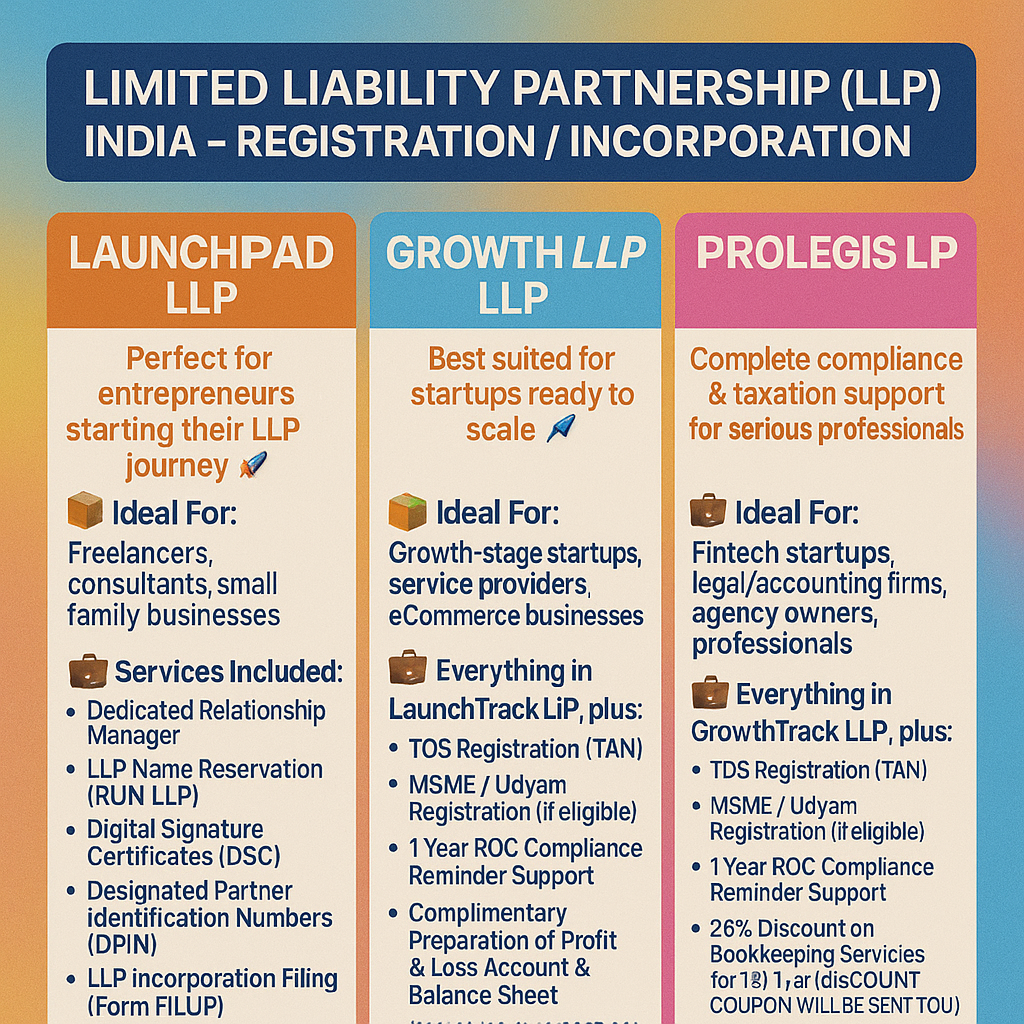
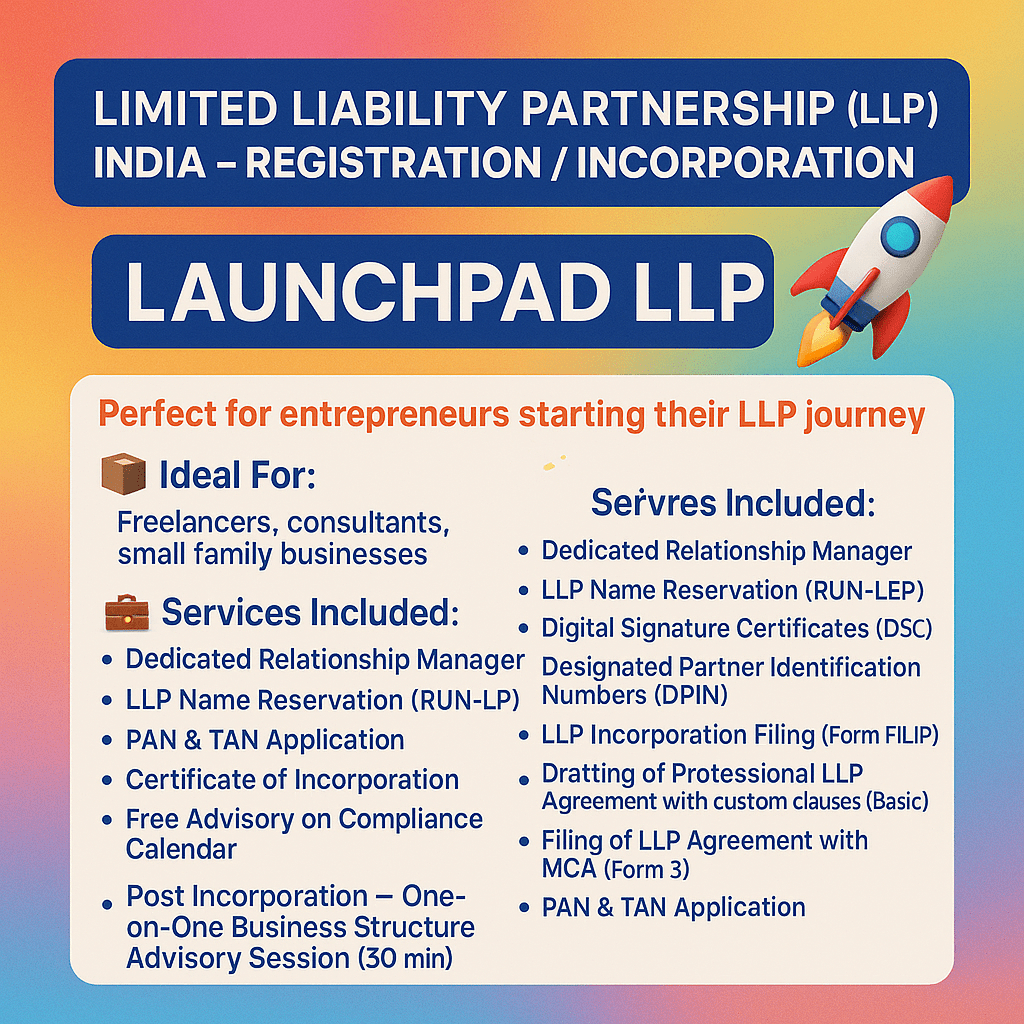
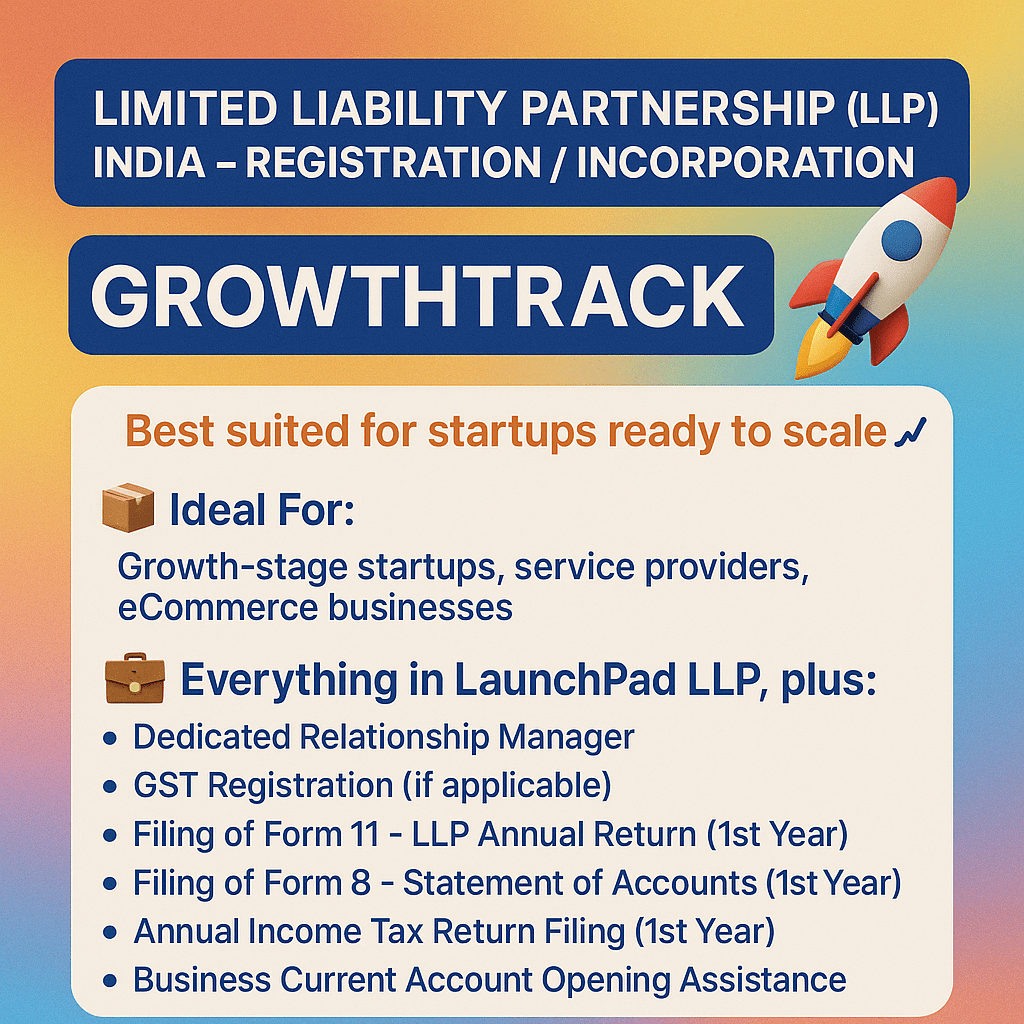
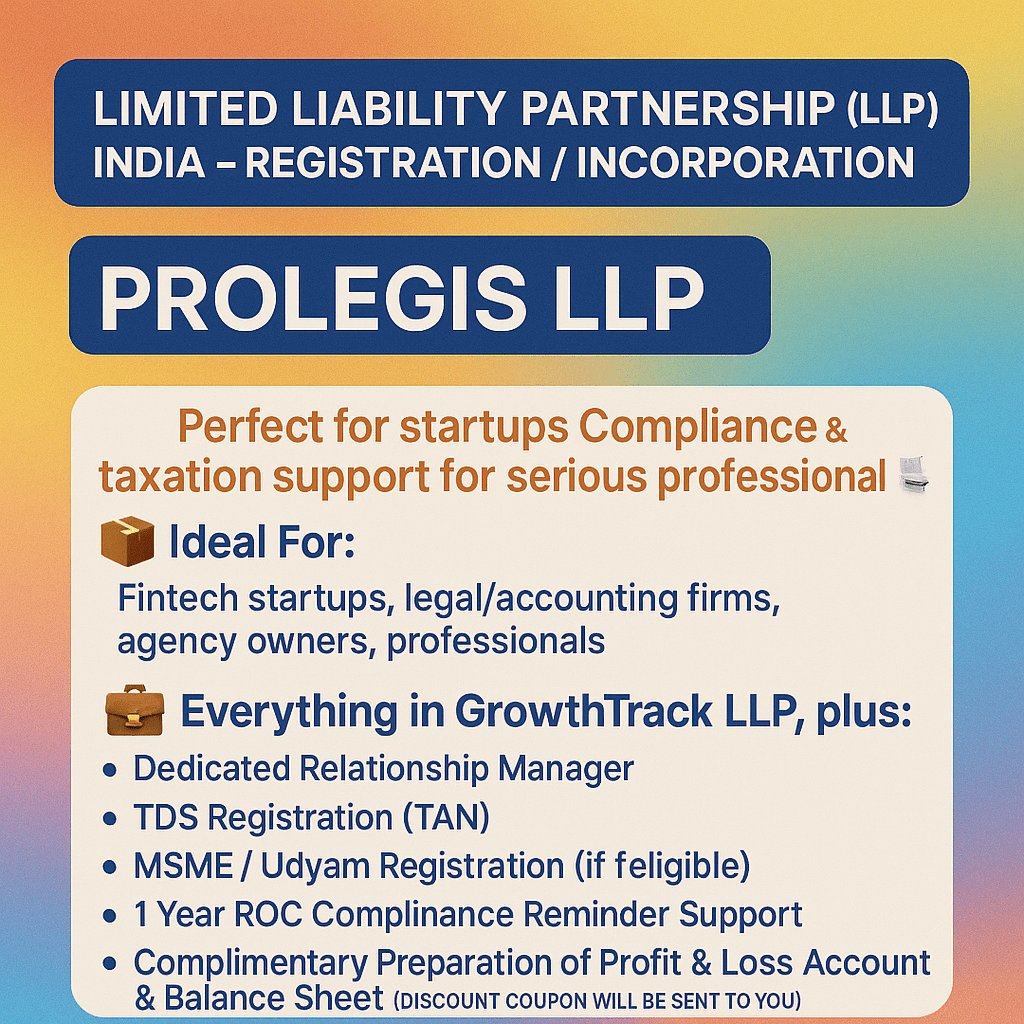




Description
🏢 General Introduction to Limited Liability Partnership (LLP) in India
A Limited Liability Partnership (LLP) is a unique and modern form of business entity introduced in India through the LLP Act, 2008. It combines the flexibility and simplicity of a traditional partnership firm with the benefits of limited liability typically enjoyed by private limited companies. This form is increasingly becoming popular among professionals, small and medium businesses, startups, and service providers due to its ease of formation and minimal compliance.
Unlike traditional partnership firms, in an LLP, partners are not personally liable for the debts of the business. The liability of each partner is limited to their agreed contribution, making it a safe and scalable structure for long-term business planning. Additionally, LLPs enjoy a separate legal identity, allowing them to own assets, sue, or be sued independently of the partners.
🌟 Main Features of Limited Liability Partnership
- 🔐 Limited Liability Protection
One of the most important features of an LLP is that it provides limited liability protection to its partners. This means the personal assets of the partners are shielded from any liability arising out of the business operations. Partners are liable only to the extent of their capital contribution.
This encourages entrepreneurs to take calculated risks, knowing that their liability is not unlimited. It is especially attractive to professionals who want to collaborate without putting their personal wealth on the line.
- 📜 Separate Legal Entity
An LLP is treated as a separate legal entity, distinct from its partners. This means the LLP can enter into contracts, acquire assets, incur debts, and be held liable independently.
This feature also increases credibility and trustworthiness in the eyes of clients, investors, and financial institutions, as they deal with an organization that is legally accountable.
- 🧾 No Minimum Capital Requirement
Unlike Private Limited Companies, LLPs do not require any minimum paid-up capital. Partners can start the LLP with any capital contribution they deem necessary.
This makes it accessible to a wide range of entrepreneurs, including freelancers, consultants, and small businesses who might not have significant capital during the initial stages.
- 🔄 Flexible Management Structure
LLPs offer a flexible internal structure, allowing partners to define roles, responsibilities, profit-sharing ratios, and decision-making processes through a mutually agreed LLP Agreement.
This adaptability makes it ideal for professionals who wish to customize operations based on their working relationships and business goals, without rigid governance structures.
- 🔍 Perpetual Succession
An LLP has perpetual succession, meaning it continues to exist even if the partners change, retire, or pass away. The death or departure of a partner does not affect the continuity of the LLP.
This makes it an ideal choice for businesses looking for long-term stability and brand continuity, especially in legacy or family-run enterprises.
- 📊 Audit Requirements Based on Threshold
Unlike companies, LLPs are required to undergo statutory audit only if:
- Their annual turnover exceeds ₹40 lakhs or
- The capital contribution exceeds ₹25 lakhs
This provides significant relief to small LLPs from complex audit procedures and allows them to focus on business growth without being burdened by regulatory compliance.
✅ Benefits of Registering an LLP in India
- 💼 Limited Liability for Partners
Partners are not personally responsible for business debts, ensuring financial safety. This makes LLPs highly suitable for risky ventures or startups where liability risk can be high.
Even in case of lawsuits or financial losses, the partner’s liability remains restricted to the capital contributed, keeping personal finances safe from business contingencies.
- 🔄 Easy Transferability of Ownership
Ownership or partnership interests in an LLP can be transferred to another person, subject to the terms in the LLP Agreement. This feature enables business continuity, mergers, or partner exits without significant disruption.
Unlike traditional partnerships where reconstitution is cumbersome, LLPs offer smooth transitions during changes in ownership or management.
- 🧾 Minimal Compliance Requirements
Compared to Private Limited Companies, LLPs enjoy lower compliance obligations, such as fewer ROC filings, relaxed audit rules, and easier annual return submissions.
This helps reduce legal costs and administrative efforts, making it ideal for small and medium enterprises or service-based startups.
- 📈 Separate Legal Entity Status
This benefit ensures that the LLP can operate independently of its partners. It builds trust with banks, government departments, clients, and vendors, all of whom prefer dealing with a registered legal body rather than individual proprietors.
This also helps in establishing creditworthiness and professional reputation.
- 🌐 Attracts Professionalism and Trust
An LLP’s structure and registration with the Ministry of Corporate Affairs (MCA) adds credibility. It is widely accepted by corporate clients, startups, and foreign investors due to its governed framework.
Professionals like Chartered Accountants, Lawyers, Architects, and Engineers often prefer LLPs to set up joint ventures or service firms due to the regulated yet flexible nature of the business entity.
📋 Checklist for LLP Registration in India
To register an LLP, the following requirements must be fulfilled:
- 👥 Minimum Two Designated Partners
At least two individuals must be appointed as designated partners, and at least one should be a resident in India. Designated partners are responsible for compliance and filings.
This legal requirement ensures accountability and proper management within the LLP, even in the case of multiple or silent partners.
- 📛 Name Reservation through RUN-LLP
A unique name needs to be proposed through the RUN-LLP (Reserve Unique Name) service on the MCA portal. The name should not be similar to any existing LLP, company, or trademark.
Choosing the right name is critical as it becomes the brand identity of the LLP. A well-thought name increases recall, brand recognition, and ensures trademark safety.
- 📝 LLP Agreement Execution
The LLP Agreement defines roles, profit-sharing ratios, decision-making authority, etc. It must be filed within 30 days of incorporation.
A properly drafted agreement ensures smooth functioning of the LLP and avoids conflicts in future. It acts as the constitution of the LLP and must be notarized and executed on proper stamp paper.
- 📍 Registered Office Address
A valid Indian address must be provided as the registered office. It can be residential or commercial and must be verified with a utility bill and NOC from the owner.
The registered address is where all legal communications and government notices are sent. It is also displayed in all official documents and website (if applicable).
- 📎 Digital Signatures & DPIN
All designated partners must obtain a Digital Signature Certificate (DSC) and Designated Partner Identification Number (DPIN). DSC is used to file incorporation forms online.
Without DSC and DPIN, the MCA portal will not accept the LLP registration application. These credentials serve as digital identification for signing and authentication of legal documents.
📑 Documents Required for LLP Registration in India
- 🪪 PAN Card of Partners
PAN Card is mandatory as it is the primary identification for Indian taxpayers. All partners must submit a self-attested copy.
It helps validate the identity and tax status of the individual and is cross-verified during the LLP registration by the Registrar of Companies (ROC).
- 🏠 Address Proof of Partners
Acceptable proofs include Aadhaar card, voter ID, passport, or driving license, with the same address as mentioned in the PAN (preferably).
Accurate address proof ensures that the Registrar has a clear record of the partners’ locations, which might be used for verification or in case of legal proceedings.
- 🧾 Utility Bill for Registered Office
A recent electricity bill, gas bill, or property tax receipt (not older than 2 months) is required to validate the registered office.
The utility bill must match the address provided in the incorporation documents. In addition, a No Objection Certificate (NOC) from the owner is required if the premises are rented.
- 🖋️ Passport-size Photograph
Each partner must provide a recent passport-sized photo for identification and government record purposes.
These photos are used in government files and the LLP master data available to the public on the MCA website. This helps build credibility and traceability.
- 🌍 Passport for Foreign Nationals
In case any of the partners are foreign citizens, they must submit a notarized and apostilled passport copy along with an address proof and visa.
This ensures compliance with FEMA and other foreign investment norms in India. Foreign nationals must also adhere to the KYC and RBI reporting requirements.
🔶 1. What Kind of Business Can Be Suitable to Be Incorporated as LLP?
🔸 Professional Services (CA, Legal, Architects, etc.)
LLP is an ideal structure for professionals like Chartered Accountants, Company Secretaries, Cost Accountants, Lawyers, Architects, and Engineers who want to work together under a common brand. The LLP allows flexibility in operations, limits liability, and avoids the rigid compliance burdens of a Private Limited Company.
🔸 Small and Medium Enterprises (SMEs)
SMEs that require a formal structure but want to avoid complex regulatory compliance prefer LLP. Businesses in consulting, digital services, and product distribution often choose LLP as it provides a corporate image with lesser compliance.
🔸 Joint Ventures and Family-Owned Businesses
LLP is a great fit for family-owned businesses or joint ventures between parties who want to clearly define roles, profit sharing, and responsibilities, while enjoying protection from personal liability.
🔸 Startups Not Seeking External Funding
Startups that are not looking for venture capital or angel investors in the short term often find LLP to be suitable. It offers a corporate setup without the pressure of issuing shares or maintaining extensive corporate records.
✅ 2. Registration Eligibility & Threshold Limits
🔸 Minimum Partners & Designated Partners
An LLP must have at least two partners, and at least two Designated Partners, one of whom must be a resident of India. The partners can be individuals or body corporates. There is no upper limit on the number of partners.
🔸 Capital Contribution Requirement
There is no minimum capital requirement for forming an LLP. Even ₹1 can be the capital contribution. However, the stamp duty on LLP Agreement may vary based on the amount of capital.
🔸 Foreign Nationals and NRIs as Partners
Foreign Nationals and NRIs can become partners in an LLP, subject to Foreign Direct Investment (FDI) guidelines. 100% FDI is allowed under automatic route in most sectors, but the Designated Partner must be a resident Indian.
🔸 Applicability of Audit Requirements
LLPs whose annual turnover exceeds ₹40 lakhs or whose contribution exceeds ₹25 lakhs are required to get their accounts audited by a Chartered Accountant under the LLP Act, 2008.
📜 3. Annual Compliances for LLP (Under LLP Act, Companies Act & Income Tax Act)
🔸 Filing of Annual Return (Form 11)
Every LLP is required to file Form 11 annually by 30th May, providing details of partners and other basic information. This is mandatory even if there is no business activity, making it a crucial compliance to avoid penalties.
🔸 Filing of Statement of Accounts & Solvency (Form 8)
LLPs must file Form 8 annually by 30th October, declaring their financial position and solvency status. If turnover exceeds ₹40 lakhs or contribution is more than ₹25 lakhs, audit is mandatory before filing.
🔸 Filing of Income Tax Return
All LLPs must file their Income Tax Return (ITR-5) irrespective of income. The due date is 31st July (non-audited) or 31st October (audited). LLPs are taxed at a flat rate of 30% plus surcharge and cess, but are exempt from Dividend Distribution Tax (DDT).
🔸 DIR-3 KYC for Designated Partners
Every Designated Partner holding a DIN (Director Identification Number) must file DIR-3 KYC annually. Failure to do so can result in deactivation of DIN and a penalty of ₹5,000.
🔸 Maintaining Books of Accounts
LLPs are required to maintain proper books of accounts on a cash or accrual basis. These must reflect a true and fair view of the state of affairs, especially important if the LLP is subject to audit.
LLP vs Partnership
| Aspect | Limited Liability Partnership (LLP) | Partnership |
| Legal Status 🧾 | LLP is a separate legal entity from its partners. It can own property and sue or be sued in its own name. | Partnership has no separate legal entity. Partners act collectively and personally for all business transactions. |
| Liability ⚖️ | Liability of partners is limited to their contribution in LLP. Personal assets are protected. | Partners have unlimited liability, and their personal assets can be attached in case of business debt. |
| Registration 📑 | LLP must be registered with the Ministry of Corporate Affairs (MCA) under LLP Act, 2008. | Registration is optional and done under the Partnership Act, 1932 with respective State authorities. |
| Compliance 📂 | LLPs are required to file annual returns and financials. Audit is applicable beyond thresholds. | Compliances are minimal. No mandatory annual filings unless registered under income tax or other laws. |
| Transferability 🔁 | LLP interests are transferable subject to agreement. Admission/retirement can be easily documented. | Changes in partners require dissolution and reconstitution, making it less flexible. |
| Perception & Credibility 🌟 | More credible due to legal structure and regulation under MCA. Preferred by vendors and banks. | Less preferred by large clients or banks due to informal structure and unregistered status. |
Proprietorship vs Limited Liability
| Aspect | Sole Proprietorship | Limited Liability Partnership (LLP) |
| Legal Status | Not a separate legal entity; the owner and the business are considered the same. | Separate legal entity registered under the Limited Liability Partnership Act, 2008. |
| Liability | Unlimited liability; the owner is personally liable for all business debts and obligations. | Limited liability; partners’ liability is limited to their agreed contribution. |
| Registration | No formal registration required; however, licenses like GST registration may be necessary based on business activity. | Must be registered with the Ministry of Corporate Affairs under the LLP Act, 2008. |
| Number of Owners/Partners | Single owner. | Minimum of 2 partners; no maximum limit. |
| Taxation | Income is taxed as personal income of the owner. | Taxed as a separate entity; profits are taxed at the applicable corporate tax rate. |
| Compliance Requirements | Minimal compliance; primarily involves filing personal income tax returns and maintaining basic accounts. | Higher compliance; includes annual filings, maintaining statutory records, and auditing (subject to certain conditions). |
| Continuity | Business continuity is affected by the owner’s incapacity or death. | Perpetual succession; not affected by changes in partners. |
| Decision Making | Sole decision-making authority lies with the owner. | Decisions are made by designated partners as outlined in the LLP agreement. |
| Funding and Investment | Limited to the owner’s resources and borrowing capacity. | Easier to raise funds compared to proprietorship and partnership; can admit new partners. |
| Dissolution | Easy to dissolve; involves settling debts and liabilities. | Can be dissolved voluntarily or by an order of the National Company Law Tribunal (NCLT). |
LLP vs Company
| Aspect | Limited Liability Partnership (LLP) | Company |
| Governing Law 📜 | Regulated by the LLP Act, 2008. | Governed by the Companies Act, 2013 |
| Legal Identity 🧾 | LLP is a separate legal entity like a company. | Private Limited is also a distinct legal person. |
| Ownership Structure 🧍♂️🧍♀️ | Ownership and management are combined. Partners run the business directly. | Ownership (Shareholders) and Management (Directors) are separate. |
| Compliance Burden 📑 | Lower compliance; only 2 mandatory annual filings. | High compliance: ROC filings, Board Meetings, Shareholding registers, etc., |
| Investment & Funding 💰 | LLPs cannot issue shares, hence not ideal for equity investors or VCs. | Preferred by investors as they can own equity shares and exit easily. |
| Taxation & Deductions 💼 | Taxed at 30% + cess. No DDT on profits shared. | Taxed at 22%-25% + DDT or dividend tax in hands of shareholder. |
| Audit Requirement 📊 | Mandatory only if turnover > ₹40 lakhs or contribution > ₹25 lakhs. | Audit is mandatory, irrespective of turnover |
| Reputation in Market 🏦 | Suitable for professionals and SMEs. | Seen as more credible for funding, government tenders, and banking. |



LLP Registration service romba smooth-aa irundhuchu.
Starting-la LLP structure, benefits ellam clear-aa explain panninaanga. Documentation, MCA filing, Certificate of Incorporation varai step-by-step guidance kuduthaanga.
Timely updates, transparent fees, and quick response romba helpful-aa irundhuchu. Any confusion irundhaa immediate-aa clarify panninaanga.
India-la LLP start panna plan pannura entrepreneurs-ku highly recommended service
Thank you for your valuable feedback! 😊
We’re delighted to know that you had a smooth and hassle-free experience with our LLP Registration / Incorporation services. Your appreciation for our clear explanations, step-by-step guidance, timely updates, and transparent pricing truly means a lot to us 👍
Wishing you great success in your business journey 🚀 If you need any further support with compliances or registrations in the future, we’ll always be happy to assist you 🤝